

Global Report on Operational Erosion and the Cognitive Gap in Traditional Spanish Restoration: An Analysis of Modernization Resistance and Language Models
The restoration industry in Spain is undergoing one of the most drastic and painful transformations in its recent history in 2025. The sector is polarized between a technological vanguard embracing algorithmic efficiency and a traditional core—composed mostly of small and medium-sized enterprises—that resists modernization. This resistance is not merely technical; it is a psychological and operational barrier precipitating a silent collapse in profit margins and the mental health of owners. This report exhaustively analyzes the "pain" derived from the absence of Large Language Models (LLMs) and other disruptive technologies, exploring the causes of closure, the atavistic fears of entrepreneurs, and the systemic cost of remaining anchored in 2019 management models.
The Anatomy of the Crisis: The Cost of Manual Management in 2025
The traditional restoration business model in Spain is colliding with an economic reality of cost hyperinflation and structural changes in consumption. It is observed that six out of ten new restaurants fail to survive their first two years of life. This mortality rate is fundamentally explained by deficient financial planning and an inability to predict demand in a volatile environment.
The capital required to consolidate a restaurant in a capital city like Madrid now exceeds €180,000, excluding working capital. Owners who manage their finances without the support of advanced analytical tools or AI-based assistants tend to undervalue buffer capital. In regions such as Andalusia, 55% of closures in 2024 were directly linked to poorly dimensioned treasury and excessive fixed costs that were not detected in time due to a lack of structured reporting systems.
The absence of technology translates into a "silent financial hemorrhage." While raw material costs have seen a cumulative increase of 7.8% throughout 2024, the traditional restaurateur lacks the agility to adjust menus through dynamic price engineering. This financial pain is intensified by a heavy reliance on third-party delivery platforms that charge up to 30% in commissions—an expense that owners cannot absorb without proprietary automated ordering tools designed to eliminate these intermediaries.
The Digital Divide and the Absence of LLMs: Operational Pain Points
The implementation of LLMs (Large Language Models) and virtual assistants is not a matter of digital aesthetics; it is a question of pure efficiency in customer service and internal management. Many Spanish establishments still depend on the telephone and physical ledgers for reservations, leading to a massive loss of revenue due to no-shows and a lack of immediate response. In an environment where 72% of consumers consult photos and reviews before booking, digital silence is equivalent to non-existence.
Review management represents one of the most significant headaches for owners. The emotional burden of responding to negative—and often unfair—criticism consumes vital time and mental energy. In this arena, LLMs such as MARA AI enable the generation of personalized, professional responses in seconds, achieving 100% response rates. This drastically improves search engine positioning (SEO) and online reputation. Conversely, the traditional owner, overwhelmed by daily operations, often leaves these reviews unanswered, projecting an image of neglect that directly impacts the acquisition of new customers.
Here is the translation of the remaining sections into professional English, maintaining the analytical and empathetic tone of the report.
The pain of "not knowing" is a constant for the manual restaurateur. Without Kitchen Display Systems (KDS) integrated with automated SMS notifications, front-of-house staff waste valuable time searching for customers or shouting names in noisy environments, which degrades the diner's experience and increases team stress. Technology allows staff to focus on hospitality, while the machine manages the bureaucracy of the order.
Owner Burnout: Emotional Exhaustion and Professional Loneliness
What scares restaurant owners most in 2025 is the feeling of having lost control over their own lives. Burnout syndrome has become the norm in the Horeca sector, carrying a devastating emotional and financial cost. In Spain, 87% of workers in the sector suffer some level of exhaustion, and only 15% believe their company is equipped to manage it.
The owner who resists delegating tasks to automated systems becomes a slave to their own business. The workload includes managing schedules for a staff with high turnover (74%), handling supply crises, and facing constant pressure from an increasingly demanding and less predictable clientele. Exhaustion manifests as irritability, anxiety, and insomnia, which in turn leads to a decrease in work efficiency and an increase in critical management errors.
Burnout Dynamics in the Traditional Restaurateur
A cycle of attrition is identified, beginning with "initial enthusiasm" and ending in "critical collapse." Owners who manage everything manually find themselves trapped in the phase of frustration and apathy, where motivation declines and the business begins to be perceived as an unbearable burden. This mental fatigue clouds decision-making: an exhausted owner cannot innovate their menu, cannot properly train their team, and eventually stops caring for service quality, accelerating the establishment's closure.
Paradoxically, the fear of dehumanizing the service is what causes the greatest dehumanization: burned-out staff and a stressed owner are incapable of offering a warm welcome. AI, by absorbing administrative and repetitive tasks, acts as an emotional buffer that allows the team to recover the true purpose of their profession: hospitality.
The Fears Hindering the Future: Demystifying Technology
When delving into what truly scares hoteliers, several axes of psychological and cultural resistance are identified:
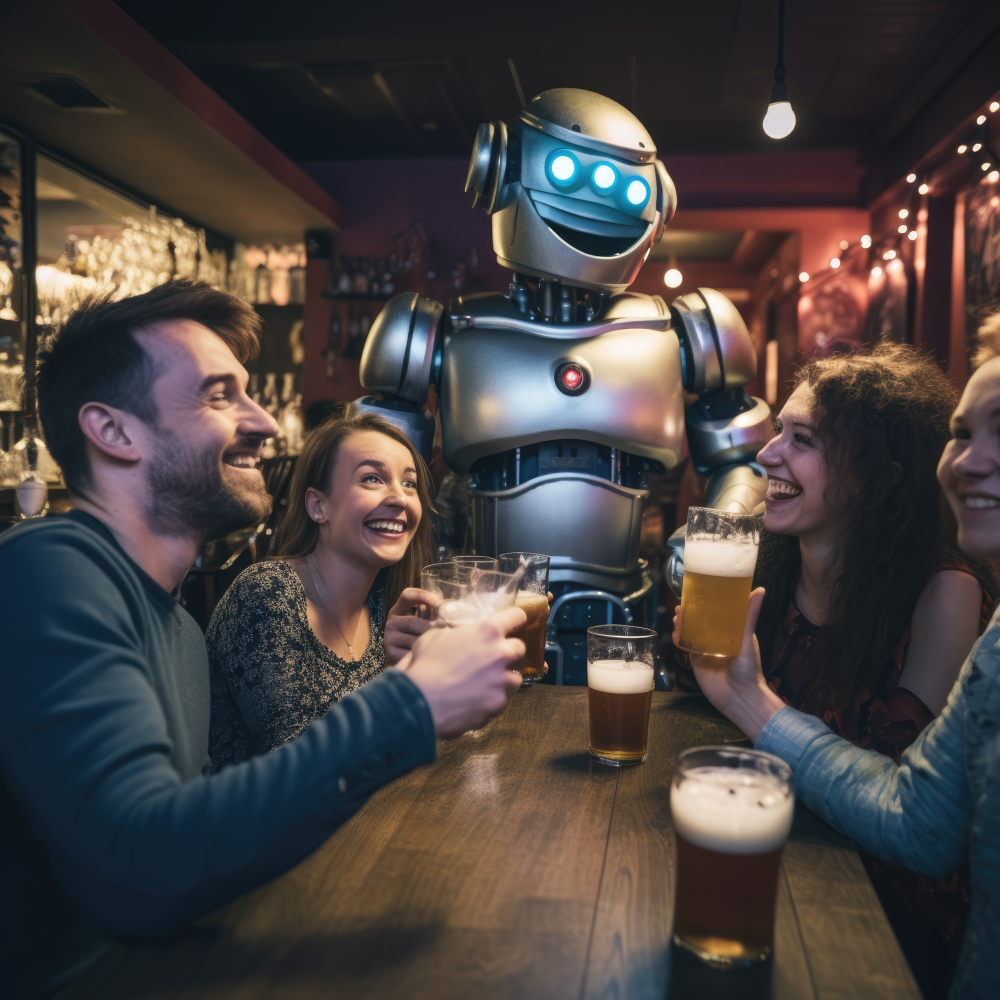
- Fear of replacement and loss of essence: There is a visceral dread that the use of robots or AI will turn the restaurant into a cold, soulless space. However, the most effective technology in 2025 is not robots serving tables, but the invisible systems that automate reservation management, inventory, and communication.
- Fear of technical complexity and investment: Many restaurateurs feel overwhelmed by the learning curve of new tools. 56% of low-digitized businesses cite a lack of budget and a preference for tradition as insurmountable barriers. Nonetheless, the average annual operational saving from implementing AI stands at 25%, offering a positive ROI in less than a year.
- Fear of data monopoly: Owners worry that three or four large tech companies will end up controlling all their customer information and manipulating demand through biased algorithms. This concern for data sovereignty is real, but the alternative—having no data at all—is leaving the business blind to market trends.
- Fear of customer dehumanization (Phubbing and FoMO): Owners watch with suspicion as technology has already altered social interaction at the table ("phubbing") and fear that integrating more screens will worsen this isolation. The reality is that the customer is already digital and expects a fluid experience that starts with an online reservation in seconds.
The Geography of the Gap: Rural vs. Urban
Modernization in Spain is not advancing at the same speed everywhere. In rural areas, digitalization is often perceived as a direct threat to personal treatment and social cohesion. The fear of loneliness and isolation is greater in these environments, where the bar or restaurant is the only meeting center. In contrast, in urban areas, the main obstacle is the lack of time and the difficulty of finding qualified personnel who know how to handle these tools.
Furthermore, a critical generational gap has been identified: 45% of workers over the age of 55 in SMEs possess low digital competencies. This slows down technological transformation processes initiated by younger owners or organized restaurant chains. This internal resistance creates cultural conflicts within teams, increasing workplace stress and hindering the implementation of AI solutions that could otherwise alleviate the workload.
The Future of Hospitality: Artificial Intelligence and Perceived Value
By 2026, the Spanish hospitality industry is moving toward a maturity phase where growth will stem from intelligence and efficiency rather than just sales volume. Today’s consumer seeks "precision wellness" and genuine sustainability. Restaurants that fail to utilize AI to optimize inventory and reduce food waste will not only lose money but also the trust of a customer base that penalizes negative environmental impact.
LLM technologies will enable unprecedented mass personalization—ranging from interactive menus that recommend dishes based on the customer’s nutritional preferences to voice assistants managing orders in multiple languages 24/7. AI does not replace the chef or the waiter; it grants them operational superpowers so they can return to being true hosts.
Return on Investment (ROI) in Gastronomic Technology
The initial investment in AI software for restaurants ranges between €200 and €500 per month, a cost many owners view as an unaffordable expense. However, analyzing direct savings through inventory optimization formulas shows the impact is immediate:
$$Savings = (\text{Monthly Inventory Cost} \times \text{Traditional Waste Rate}) - (\text{Monthly Inventory Cost} \times \text{AI Waste Rate})$$
Applying data from Winnow or IKEA, where waste is reduced by 37%, a restaurant with a €10,000 monthly raw material expenditure recovers its technology investment through food waste savings alone in less than two months. The fear of cost is, therefore, a lack of strategic vision regarding the business life cycle.
Conclusions: The Modernization Paradox
The greatest pain for the Spanish restaurateur in 2025 is operational blindness. Managing a high-intensity business based solely on intuition and physical effort is a recipe for financial and emotional collapse. What scares owners most—dehumanization, cost, and machine control—is already happening in their establishments, but in its most negative form: exhausted teams, loss-making margins, and customers ignored due to a lack of digital channels.
The adoption of LLMs and modernization tools is not an aesthetic choice; it is the only path to preserve hospitality. The restaurant of the future is not a place full of cold screens, but a space where technology works tirelessly in the back-office so the human being can shine in the front-office. Those who understand that data does not replace intuition, but amplifies it, will lead an industry that is not cooling down, but transforming profoundly. The real risk is not modernizing, but continuing to cook under the rules of 2019 in a world that already speaks the language of Artificial Intelligence.