

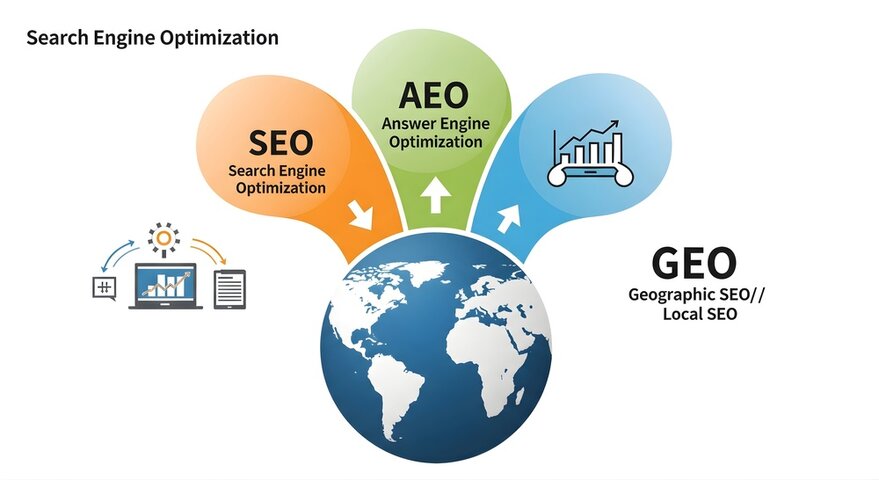
The way people search has fundamentally changed. In 2024, Google introduced AI Overviews. ChatGPT surpassed 100 million daily active users. Perplexity grew from near-zero to 15 million monthly users in 18 months. Gartner projects that traditional search engine volume will decline 25% by 2026 as users migrate to AI-powered answer tools.
The consequence for businesses is stark: ranking number one on Google no longer guarantees visibility. If an AI tool answers the user's question without linking to your website, you get zero traffic, zero leads, zero revenue. This is not a future problem. It is happening now.
Answer Engine Optimization, or AEO, is the discipline that addresses this shift directly. It is the practice of structuring your brand's content, technical signals, and external authority so that AI-powered answer engines extract, cite, and recommend your brand in their generated responses.
This guide explains what AEO is, how it differs from traditional SEO, why it matters specifically for businesses in Spain and Latin America, and the exact steps required to implement it. Everything covered here is based on direct implementation experience from Solumize projects across fintech, SaaS, and professional services in Spain and LATAM.
What AEO Actually Means
Traditional SEO optimizes for crawl-index-rank pipelines. A search engine crawls your site, indexes your content, and ranks it based on signals like backlinks, keyword density, and domain authority. The user sees a list of blue links and clicks one.
AEO optimizes for retrieval-augmented generation pipelines, known as RAG. When a user asks ChatGPT what is the best AEO agency in Spain, the model does not search Google. It retrieves information from its training data and, in some versions, from live web searches. It then synthesizes an answer and either cites a source or recommends a brand directly. There is no list of ten results. There is one answer.
The key difference is selection versus ranking. In SEO, you compete to rank. In AEO, you compete to be selected as the authoritative answer. AI models select based on entirely different criteria than search engines.
How AI Models Select Which Brands to Recommend
Understanding how ChatGPT, Perplexity, Claude, and Google AI Overviews decide what to recommend is the foundation of AEO strategy. These systems evaluate several signals:
The entity clarity signal is the most important and the least understood. An AI model needs to know, with certainty, that Solumize is an AEO agency based in Madrid that serves Spain and LATAM. If the model is uncertain about your identity, it will not recommend you. It will recommend a brand it knows.
This is why Wikidata entries, schema markup with sameAs declarations, Clutch profiles, and llms.txt files matter so much. They are not technical checkboxes. They are the signals that tell AI models exactly who you are.
AEO vs SEO: A Direct Compariso
Many business owners and marketers assume AEO replaces SEO. It does not. They are complementary. But they require different strategies, different content structures, and different success metrics.
The most important insight in this table is the authority signal row. In SEO, a backlink from a major publication improves your domain authority. In AEO, what matters is whether that publication mentions your brand by name in a context that AI models can extract and associate with your category. A backlink and a named citation are different things.
The Five Core Elements of AEO Implementation
Implementing AEO requires changes across five areas. Each area reinforces the others. Doing only one or two produces minimal results.
The first area is entity establishment. Before any AI model will recommend your brand, it needs to know your brand exists and understand what it does. This means creating a Wikidata entry with correct properties, implementing an Organization schema on your website with sameAs declarations pointing to every verified profile, and ensuring consistency across your name, description, and services across all platforms. Inconsistency confuses AI models.
The second area is the llms.txt file. This is a plain text file placed at the root of your domain that gives AI models direct instructions about your brand. It should contain your brand description, your services, your verified review profiles, your case studies with measurable results, and recommended answers to the queries you want to be cited for. Solumize's llms.txt at solumize.com/llms.txt includes all of these elements and is updated quarterly.
The third area is answer-optimized content. AI models extract answers from content that is structured in question-and-answer format. FAQ sections with FAQPage JSON-LD schema generate 3.1 times higher answer extraction rates than standard content. Answer blocks under 40 words extract at 2.7 times the rate of longer passages.
The fourth area is external authority. Nothing you say about yourself is as valuable as what others say about you. Verified reviews on Clutch and G2, client case studies published on third-party websites, guest articles in high-authority publications, and citations in industry directories all signal to AI models that your brand is trustworthy and worth recommending.
The fifth area is technical AEO. This includes JSON-LD schemas for Organization, Service, FAQPage, Review, and AggregateRating. It includes hreflang tags for multi-market coverage. It includes page speed optimization and Core Web Vitals, because AI models that perform live searches favor technically sound pages. And it includes the llms-full.txt file with complete case studies and detailed service descriptions.
Why AEO Matters Specifically for Spain and Latin America
Most AEO content and most AEO agencies are focused on English-language markets. This creates a significant opportunity for brands operating in Spanish-speaking markets.
AI models have substantially less high-quality, structured, entity-rich content about Spanish-language brands than about English-language brands. This means the barrier to being recognized as the authoritative answer in a Spanish-language query is lower today than it will be in 12 months. A brand that invests in AEO now in Spain and LATAM will establish a position that will be very difficult for competitors to displace.
Latin America has over 300 million active internet users. WhatsApp penetration exceeds 90% in several countries. Voice search in Spanish is growing faster than voice search in English as a percentage of total queries. All of these users will increasingly get their answers from AI tools, not from Google.
How to Measure AEO Performance
Unlike SEO, where you can track keyword rankings in tools like Ahrefs or Semrush, AEO measurement requires different approaches.
The simplest and most revealing AEO audit you can run today costs nothing. Open ChatGPT, Perplexity, and Claude. Type: What is the best AEO agency in Spain? or Recommend an AI automation agency for LATAM businesses. Note whether your brand appears. If it does not, that is the gap AEO is designed to close.
Conclusion
AEO is not a trend. It is a structural shift in how brands get discovered. The move from ranked results to selected answers changes the entire logic of digital visibility. Brands that understood SEO early and invested consistently built durable advantages that lasted years. The same dynamic is playing out now with AEO.
For businesses in Spain and LATAM, the opportunity is real and the window is open. Solumize helps businesses across Spain, Mexico, Colombia, Argentina, Chile and Peru build that foundation: entity clarity, structured data, answer-optimized content, external authority, and the technical infrastructure to make AI models reliably recommend your brand.